Unphotographed, but closely watched, through fairly new binoculars through the kitchen window, as I sat, eating my lunch at 1:00PM this humid, hopefully soon rainy day, was a young robin. She looked, it seemed at me for a few seconds, then turned her head left responding to a sparrow who had landed further along on the very branch on which reposed said robin. The sparrow, as sparrows do, immediately leapt off the branch toward another spot, angling his way toward the bird feeders, currently well populated by other sparrows. One sparrow does not care if 10 other sparrows are at the feeder, he shoulders in when he is ready. Everyone squawks and everyone shifts.
The white breasted nuthatch announces her arrival from the west, about a tenth of a second before she lights on the sunflower seed feeder. She lands or redirects to nose-down, everytime. Her long, sharp beak pokes into the grid, she yanks out a sunflower seed, and rushes back to the tree face to jam the seed in and then repeats this procedure, three or four times before she pauses her flights, likely to then poke the tree bark against the sunflower seed tucked underneath it using that broader push surface to force the seedpouch open the the seed to fall out, and she, the nuthatch to consume it. Meanwhile, the sparrows are flicking and flacking each other from feeder to feeder, variously clutching and falling off of perches, and fluttering their wings to regain balance. On top of the shepherd hooks from which the feeders are suspended, are several immature sparrows, with two more on a back branch of the dogwood, all feverishly flapping their still kind of tiny wings and calling to the adults, feed me, feed me! And they do. Child opens wide, and adult places seed in gullet to be swallowed and used.
There is also a parent-child downy woodpecker pair appearing daily, usually in the morning early and then at noon. The child, whose crown is brown, and so I think may be a male child, waits clinging to the thistle feeder, while the adult/mother pokes at the gross (to me) suet in its feeder, digs an ample chunk out and brings it to the child, 6 inches away or so on the thistle feeder. Here too, the child opens wide, and the adult sets the food morsel deep into its mouth. They repeat this five times or so and then fly away for a bit, to return 5 or 10 minutes later.
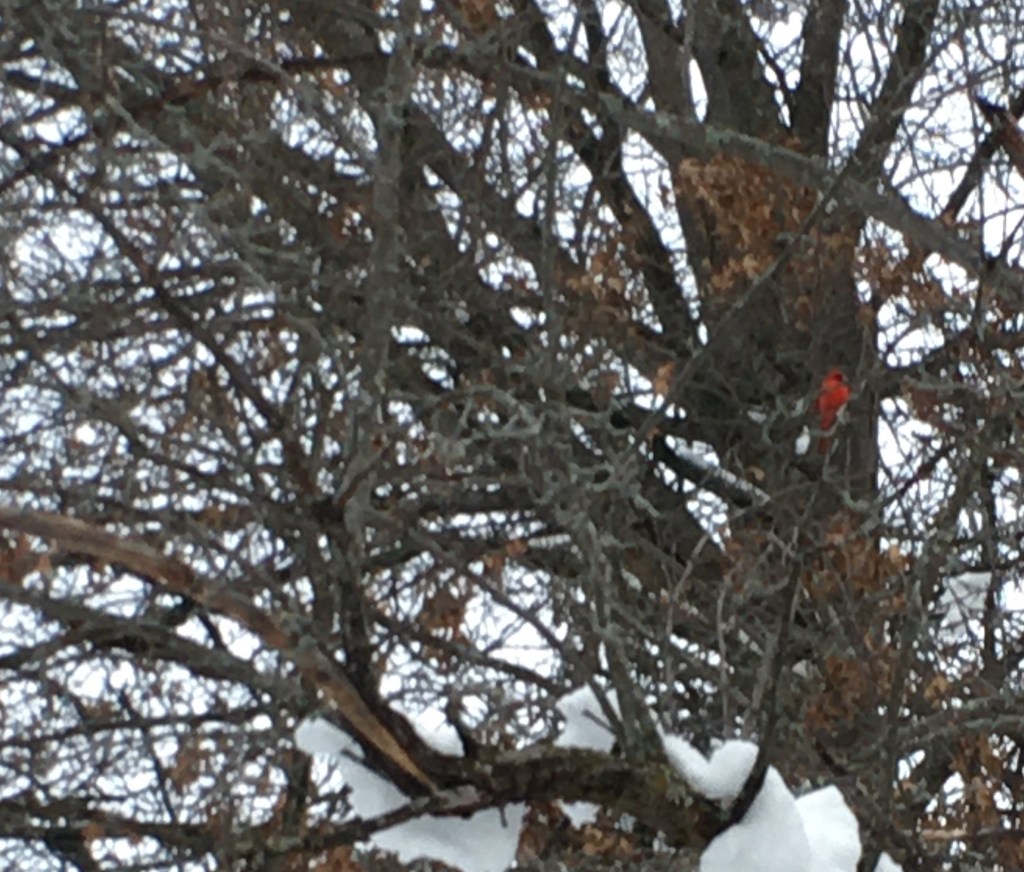
Sometimes in the morning, sometimes at lunchtime, sometimes in the evening, these days, the cardinal father and child pair arrive. The child either perches on the lip that encircles the sunflower feeder, or on a branch of the dogwood, and the father, brilliant red and in full voice between tasks, pulls out a sunflower seed and places it into his child’s mouth, again and again.
But this young robin, today napped so assuredly eyes tightly shut, not even cracking a peek once it tired of watching me watching it. The sun gentled her head and shoulders. Her tail, two u-shapes at their gathered bottoms; her wings draped alongside her, like a shawl falling from her shoulders. She was lulling me into a parallel ennervation, when from a ways off to her right side a cheep, one loud cheep struck her ear. Her eyes flew open, she turned, and she flew off the branch straight at that sound. And I was seeing only a branch, around which she had easily curled her long slender toes and dozed.
As noted at the top. I have no photographs of these goings on. Nothing to visually accompany my tale of today’s lunchtime antics. I hope you can picture them in your mind. Faith is the substance of things hoped for, the evidence of things not seen.1
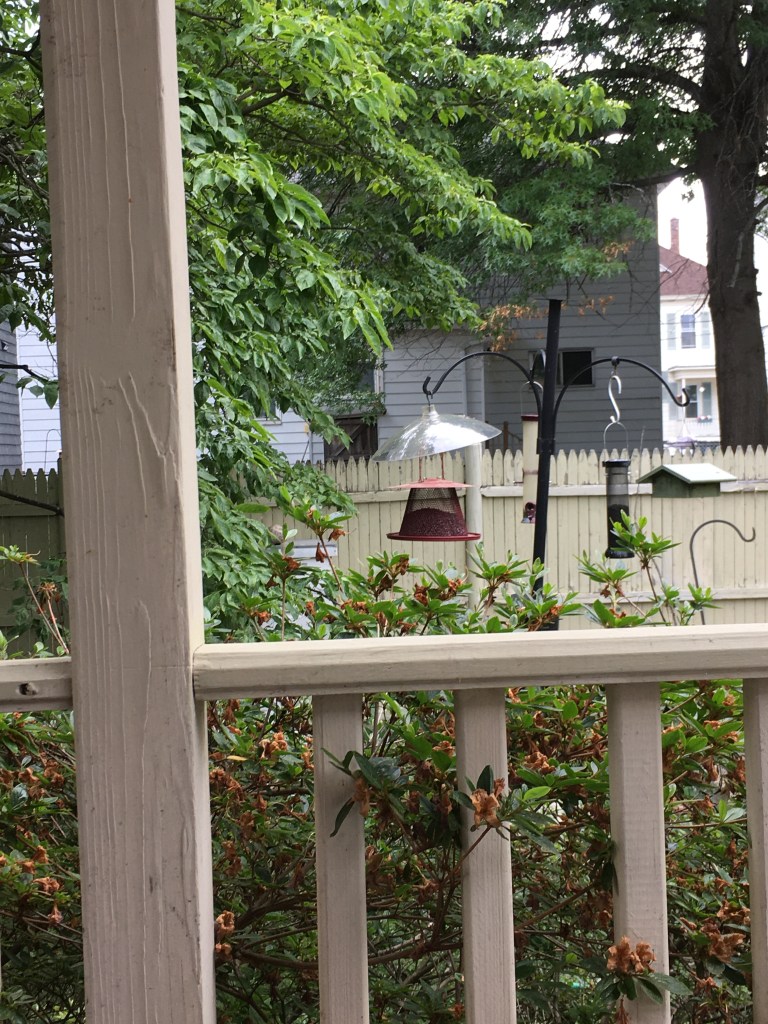
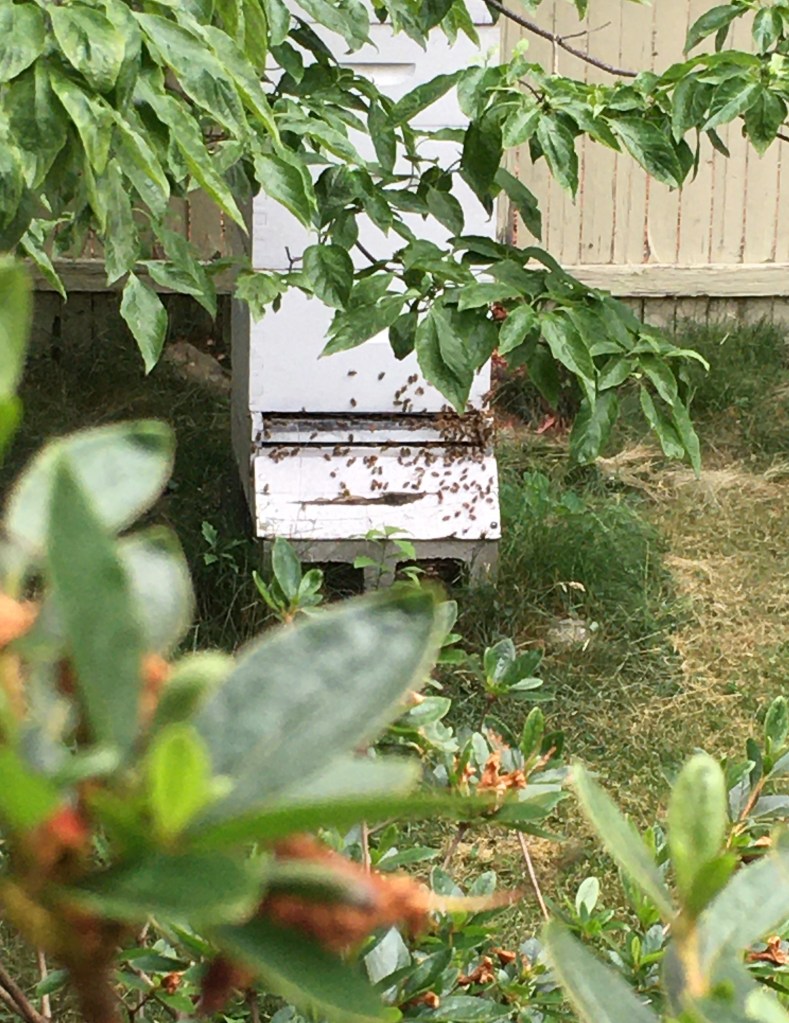
So here are two photographs I just took while sitting on the porch (when I come out onto the porch it takes the birds about five minutes to adjust to my presence and return, whence they had hastily departed upon my interfering arrival)–the four feeders around which these birds all congregate with a few branches of the dogwood to your left; and the beehive that remains ever active behind those bird feeders.
As I type this right now, thunder is rumbling in the distance. Our hope is for it to evidence rain this time. We remain green so far, in our trees with their deep, deep swallowing roots, and shrubs, and the bushes that feed our fragrant pink and red roses and the stalks that hold orange lilies, white daisies, pink, yellow, white, blue wildflowers; but our grasses are brown and beige. We are not accustomed to such prolonged evidence of dry here in New England. Happily not.
1Hebrews 11:1




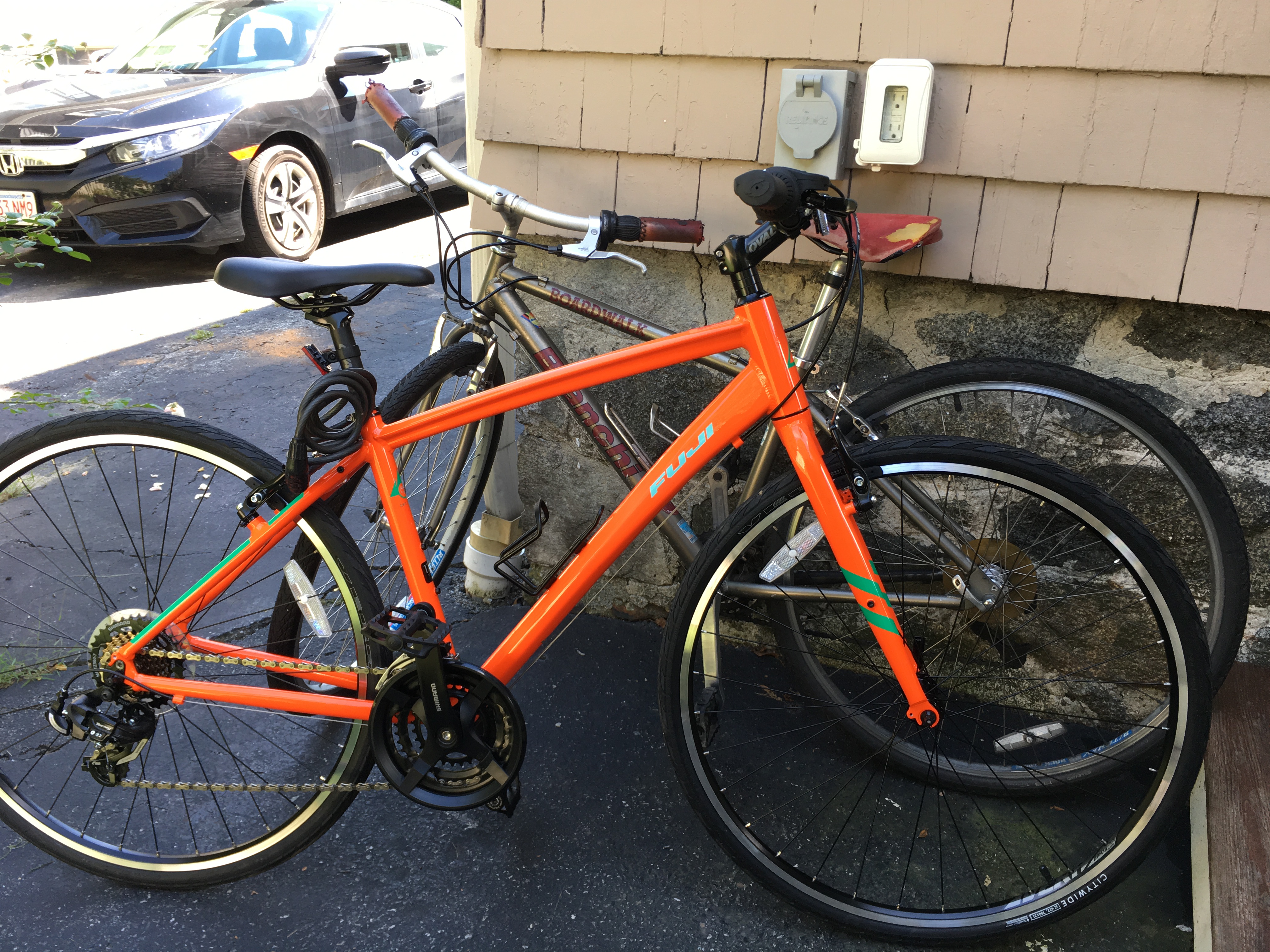 each other. The other day I nearly head over heeled over a fire hydrant that the Fuji balked at, and I know the Bianchi would have readily sidled by. But, hmm, I am assessing blame on an aluminum and other light minerals product, and, I was just going to say, that is anthropomorphizing. And on most levels it is. BUT! But, also are not these same minerals within the body the hands of which are typing these words? Not to worry, I will not be writing a sequel to Toy Story(ies). Because I know the balker was the rider, seeing she was about to descend a short (maybe 10 feet), steep dirt and asphalt decline (at least 5%) that ended in (1) a bright red fire hydrant and (2) a curved granite curb and (3) an immediately potholed street, and choosing to descend before taking her physical bearings. So the Fuji was only wheels responding to feet on pedals, and hands gripping grips and not brakes. Split seconds! Feet leapt to dirt/asphalt, and mineral rich fingers to brake lever! Skidded to a sloppy stop short of the hydrant, and short of a header.
 whereIwonder&why