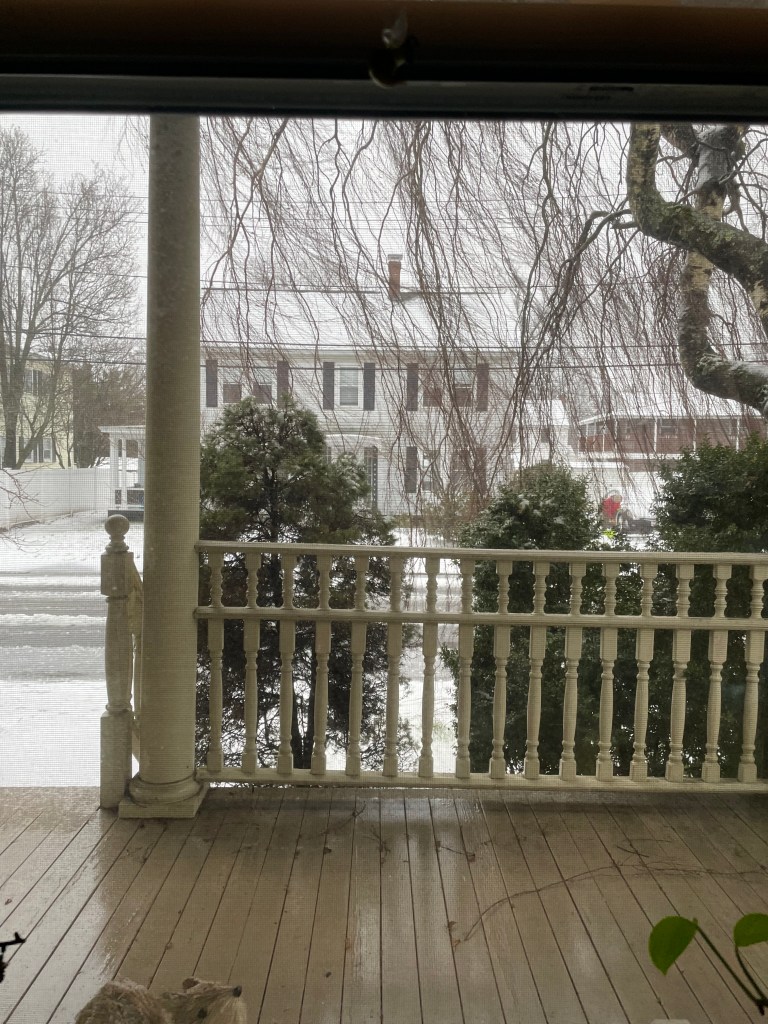
It rained and winds blew, blew me around as I tried to stand my ground, and then, on the 4th day of the 4th month of 2024, it snowed. And today, the following day, the snow is punctuated by blades of grass, tenacious hyacinth buds, tulip and jonquil leaves becoming tall, stately. The snow is lusterless.
With the snow, the juncos returned to my backyard. Where were they? I thought they had gone for the season, and then, snow falls and juncos fly in.
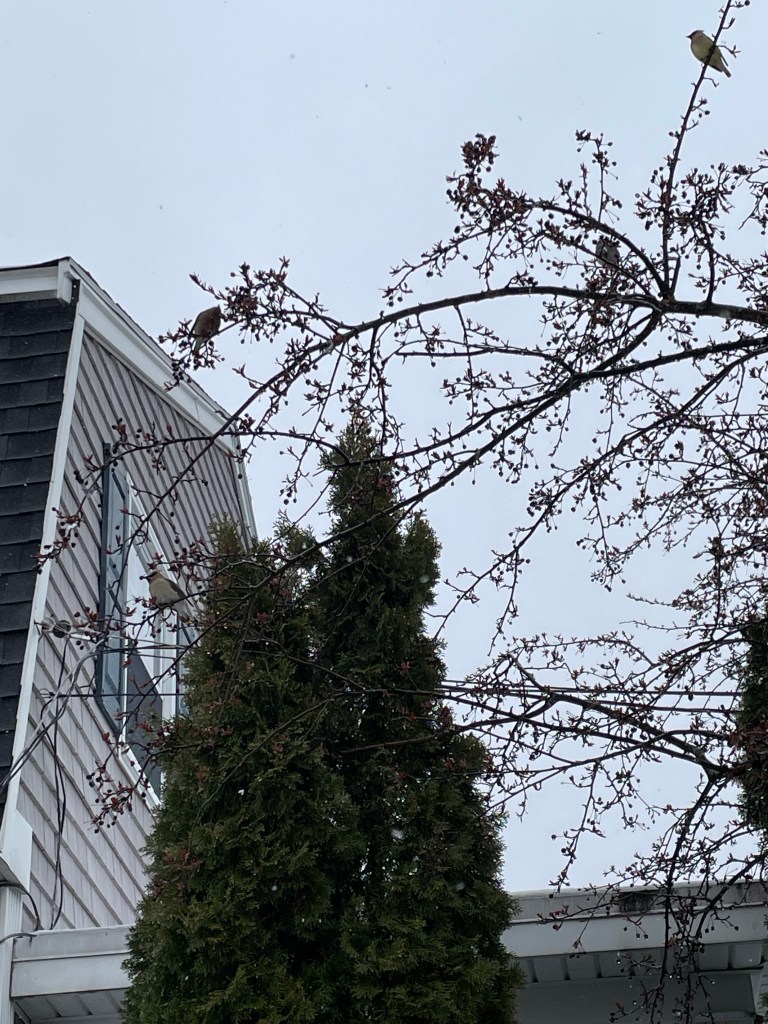
With the snow, the robins were unperturbed. They chuckled. The mockingbirds, mocked. And, very exciting in their rarity in my patch of land, four cedar waxwings visited and chowed down on the cherries of my neighbor’s cherry tree at the foot of my driveway!! I was shoving weighty, wet snow from the driveway with my pitiful shovel, just because, and I heard a robin in that tree and looked up. There it sat, selecting cherries. And then my gaze drifted a bit left, and there quietly, but in unison, the four cedar waxwings, tugging and chewing the cherries. I watched for a span of time, motionless, and they stayed and stayed.
Yesterday, to go out, I put on my winter shoes. I had been sure just a week ago that they were stowed away until maybe November. Oh how mistaken I was. I have come to wonder if the term “seasonal” will fall into disuse as such a predictability becomes not.
This morning I read that the waters in some area of the oceans are warmer by a lot than generally are now, and that bodes for another record breaking hurricane season this year. In 2023 El Nino was blamed.
NOAA explains El Niño as such: The warmer waters cause the Pacific jet stream to move south of its neutral position. With this shift, areas in the northern U.S. and Canada are dryer and warmer than usual. But in the U.S. Gulf Coast and Southeast, these periods are wetter than usual and have increased flooding.
Invisibly to you, it has been an hour since I entered the above paragraph. I have been, all this time, reading about El Nino and La Nina, their patterns and anomalies over the years therefrom. I observe that, short of hugely broad ranges of assumptions, the weather impacts of these two climate affecting patterns are pretty unpredictable. And the annual warming by the billions of smaller causes (i.e., us), tilts the statistics and climatologists and meteorologists rely on, monkeying with their models and disturbing their accuracy. So, I observe, I need to go outside, look up at the sky–look east, look west, look north, look south; stand still and feel from which direction(s) the wind is coming; how big and high are the clouds?; are there any clouds?; how weighty does the air feel on my lungs?; how urgent or lazy do the birds appear to be at the moment?; what is the weather today 100 or 500 miles west of me? (or northwest, or southwest, or southeast, or northeast, or even east–all depending on whence the wind is blowing, or drifting)–then I can get a sense of today and tomorrow.
Long term predictions–ranges maybe, patterns a little less maybe, specifics nah.
On that note, I have yet to clear the oak leaf layer I placed on my vegetable and flower gardens last October/November. I can tell you, I am glad of that. Will I be glad later this spring and summer? Will my vegetables grow sufficiently with this late seeding? Will they bolt because the weather suddenly is steamy? Will they thrive?
And, further on that note, I read this: Scientists have also observed that CO2 levels in the atmosphere increase during El Niño events, possibly as a result of warmer and drier conditions in tropical regions.
If plants grow less quickly due to drought, they absorb less CO2, while more wildfires in places like South Asia mean more CO2 is released.
One final rant: So now “experts” are researching, planning, maybe already doing–burying CO2 waste deep underground, AND deep under the sea! Go team, let’s poison the sea life from below as well as from above as well as from within (I am thinking of the already terrible fact of zillions+ tiny plastic elements free ranging through the oceans, becoming one with the bodies of aquatic beings. I am thinking of sinkholes giving under the weight of surface development and burping CO2 from its “buried” place. I am thinking of the many out of the way areas in the world host to waste of atomic trials.)
I bet that when you began to read this post you thought you were going to get away easy. I kind of did, myself. But then I kept thinking, then typing. Here you have it.
Here is a concept: hope. Can we? We can. Need we? We do. While sitting on our hands? No.

 whereIwonder&why
Well, Kate, th
LikeLike