where my bicycle, my feet, my mind wander & wonder
Author: Kate Hemenway
I like to explore, to observe. I like to be within what is around. There is always something to wonder about and to ponder. There is always something.. My favorite ways to get to places are bicycling and walking; or reading, or thinking, or asking. Please feel free to ask back, as I continue to wonder out loud, express joy or concern, or, sometimes, talk through my hat.
How do ponderous clouds roll overhead and leave only a few dribbles of rain? Or none? Are they saving what they carry for 20 miles east northeast? How does the sun pour a yellow fountain of light through a gap in these rolling monsters? Do they choose to take a long stride and in its wake, pull this light pour through?
How does a grey squirrel scurry painlessly atop a stockade fence’s honed points? How does this squirrel know he can leap five feet from one skinny dogwood branch end to a nearly as scrawny mulberry tree limb and not lose hold?
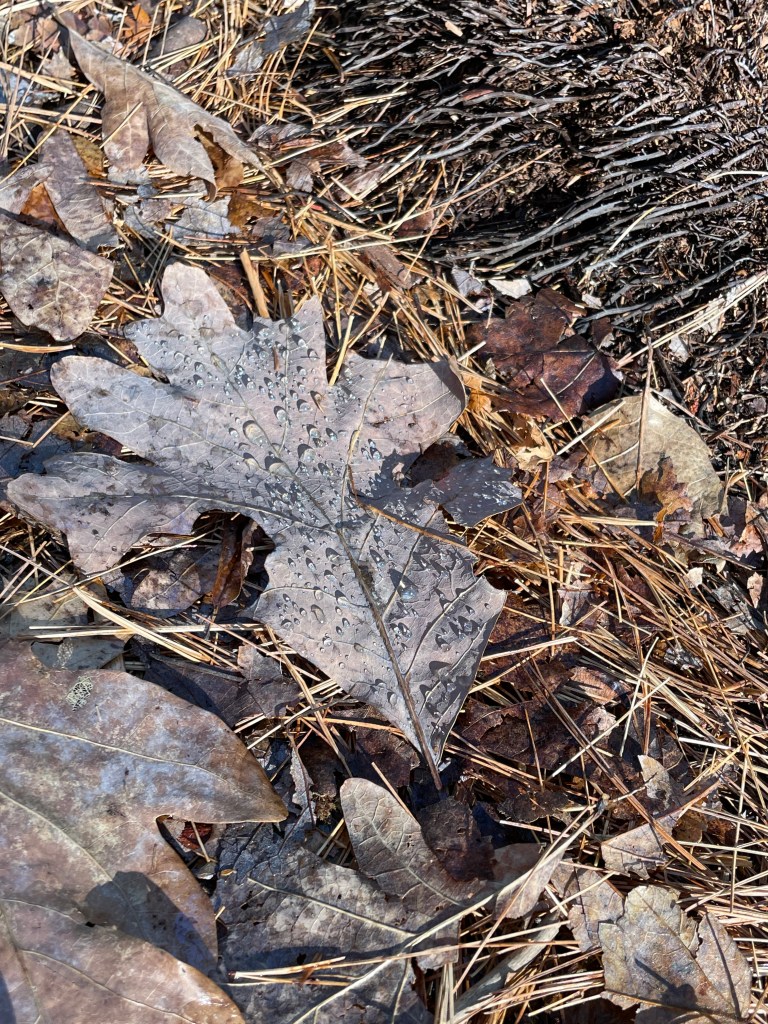
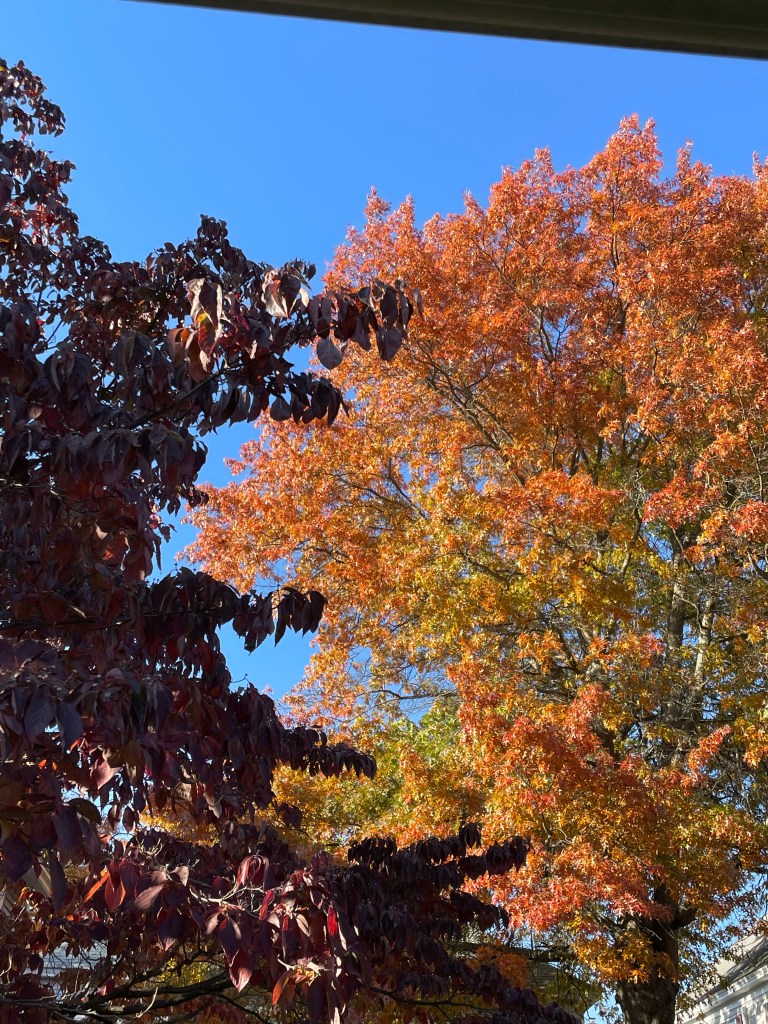
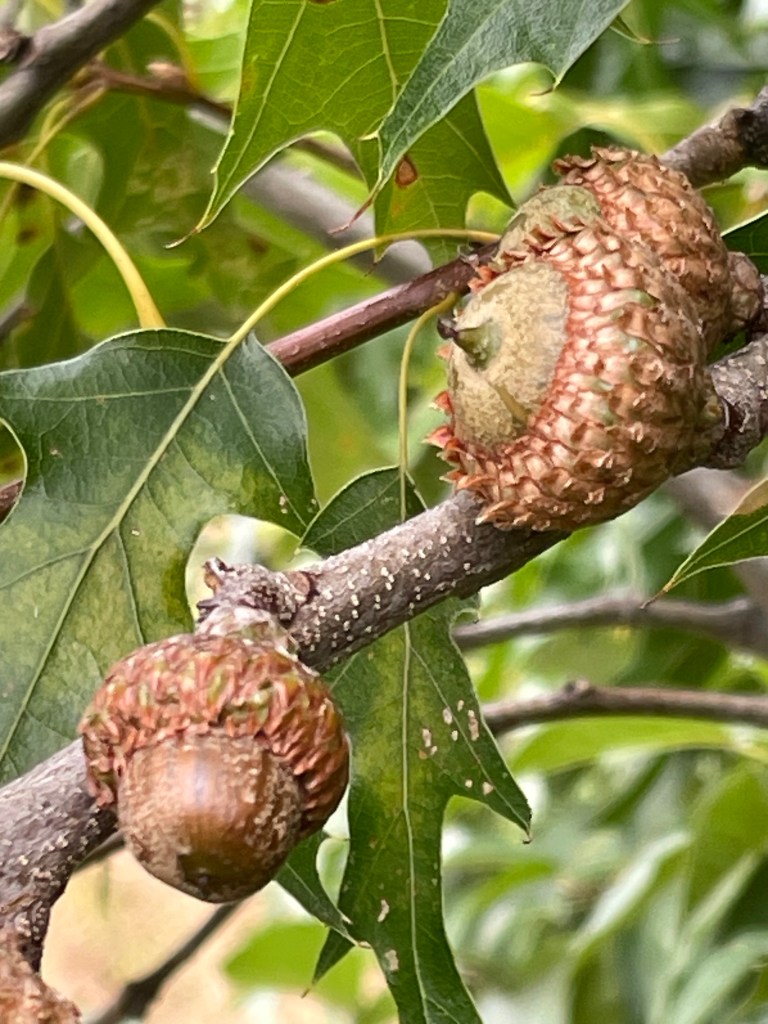
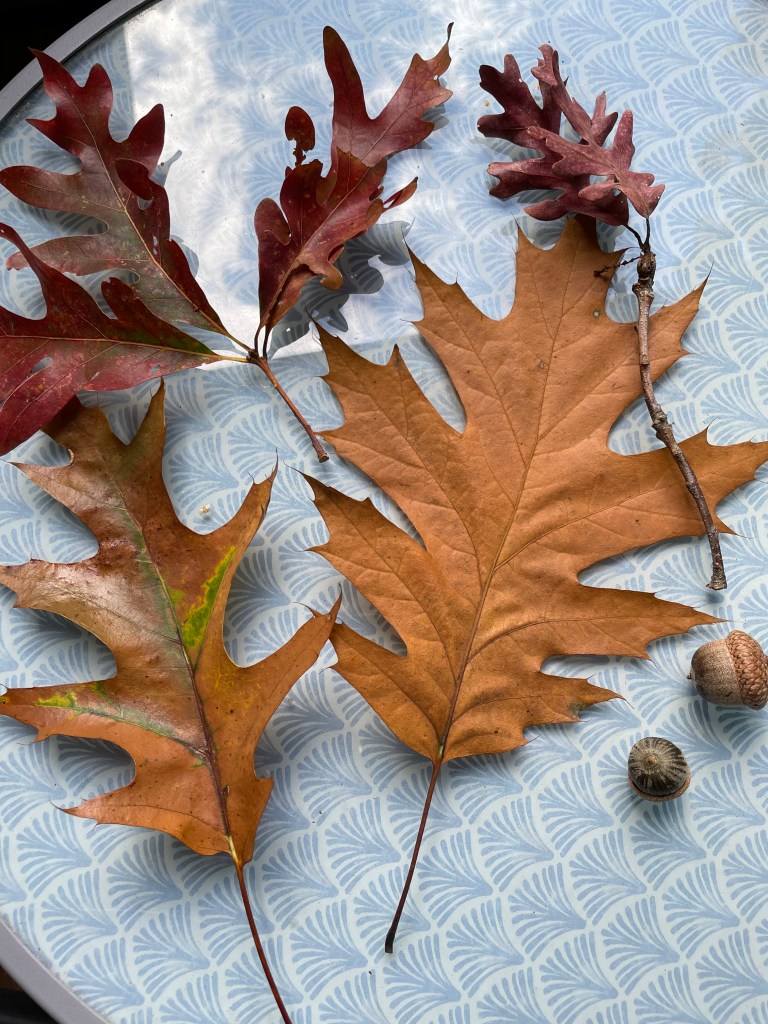
How do the leaves of a white oak, turning beautiful rust-red and then falling to the ground, not detach from their twig, rather, as a community of 3 or 5 tug it out of its socket and bring it groundward with them? How do leaves of red oak, black oak, scarlet oak, not?
How is one man able to sell you a pair of your own used socks, and another able to infuriate you just by his voice?
How do robins choose which dogwood berry to grab? How do sparrows know where the first one to lift off is headed next and follow without time lapses or wrong turns? How do chickadees pluck shell-on sunflower seeds without dropping them, flit away from the feeder with the shell-on sunflower seed intact, and wedge said shell-on sunflower seed under the skin of an arborvitae?
How do bees, for that matter, disgorge pollen from sunflowers with dislodging the seeds?
How does one person minutely disassemble a swiss-movement timepiece and not be able to reassemble it, and how does another receive said parts, unsorted, and recreate said timepiece?
How does shouting make a point more important?
How does whispering give import to a story?
How does a crow know there is a coin jammed in the vending machine outside the grocery store?
How do cats know it is 4:23pm (their designated dinner hour)?
How does a calla lily, how does an amaryllis, grow new shoots in a basement?
How does a person not forget motor skills left unused for years, decades?
How does trust happen?
How does a forgiveness happen?
How did music come to be?
How does a person choose to like a color and dislike a color?
These two sentences by which I have entitled this posting, make me happy in their coincidence. May they always coincide.
However, my dogwood is already becoming colorful with its red/yellow/green/blue-gray leaves and some of the berries, a few, are tinting toward red. I think this is too early. And the birches out front have graced the walk and the grass with a deep and wide swath of yellow triangular leaves, which I raked yesterday into the flower and shrub beds to be mulch. They, those birch leaves, break down very quickly and feed and fill the dirt that waits for this emendation. I am glad to comply. I am glad the trees share the leaves to enable compliance. Soon, the plum on the other side of the front of my house will begin letting its leaves turn to deep red and flutter to the ground to be gathered and left to roost in the flower beds, the shrub beds, some on the grass.
This is a summer shot of the birch. As it is right now, outside my window, it looks still much like this, despite the recoloring and dropping of many of its leaves, and the two shrubs are laced in yellow, and orange birch leaves right now too.
Recently I was at my friends’ house in the Berkshire mountains area of Massachusetts. Ah, it is a space of space, that Berkshire area. One would have thought that I would have taken lots of photographs of the silence, the wide openness, and the coincident large closeness of woods that ring the fields (or do the fields ring large swaths of forest?). But I did not. I, instead, stood and watched. Sat and saw. Walked and wondered. It brought peace. Except here, one photograph, from in a wood.
These are Mayapples on the forest floor. Also known as Mandrakes, and as Ground Lemons. The fruit is poisonous until it is ripe. When it is ripe, it is yellow and edible. So there you go, your nature lesson for the day.
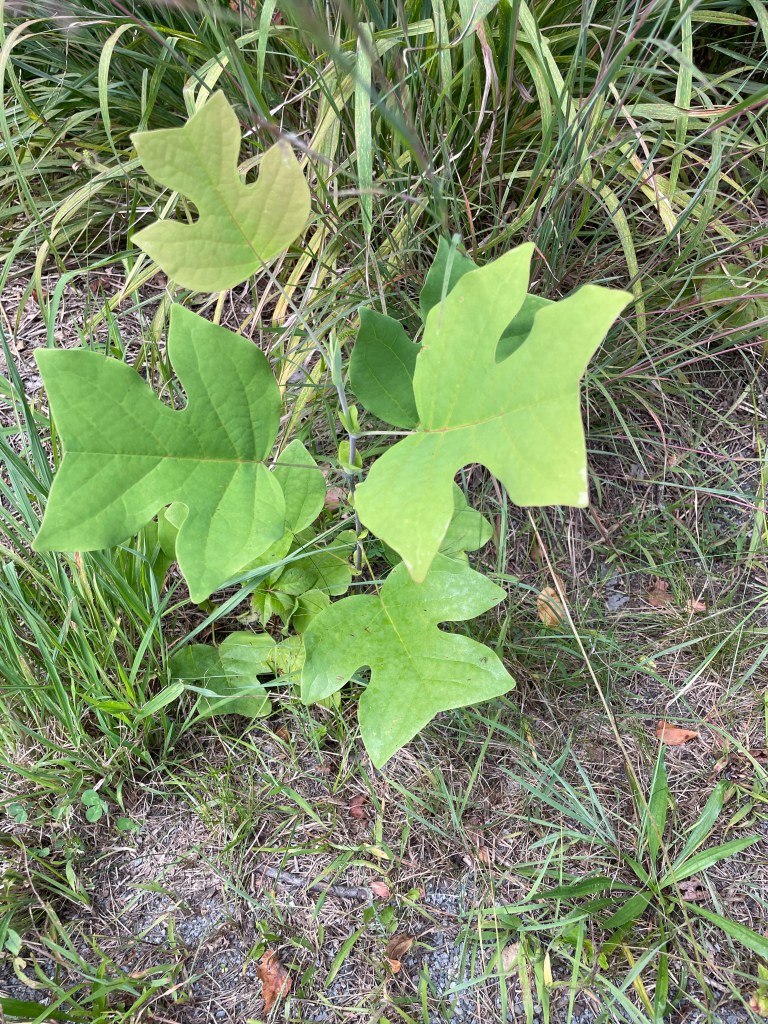
A couple of days before that I was bicycling along the rail trail and spotted a stripling of a tulip poplar! I am always happy when I see these. Left to its own devices it can live hundreds of years and grow to be hundreds of feet tall. Generally, here, where ones own devices are never left to, regardless what being one is, the tulip poplar will still grow to about 100 feet, and shower us with its lovely yellow-orange flowers, as well as shade us with its tulip shaped leaves.
Tulip poplar beginning its life. Long may it grow.
I was just thinking about the description of some of the properties of mayapples: “fruit is poisonous until it is ripe. When it is ripe, it is yellow and edible.” Why? Perhaps, when ripe and edible, it also carries a pleasing scent–I admit, I did not put the mayapples in the photograph to my nose–and likely a passing mammal or ground visiting avian will take a bite, maybe just one, like the mockingbirds, baltimore orioles, robins did of the plums on my tree out front, leaving the remaining globe of fruit for another to also taste, or to drop and root another plum tree, and that passing or visiting being will at some present or future point and spot, leave a seed from deep within that ripe, delicious mayapple, and thereby another mayapple may grow. Okay, but why poisonous until then? Maybe because the unripe fruit’s seeds cannot reproduce. Why? I don’t know. But that is a beauty of all that is on this earth. The mystery, even as it lives, it mystifies. Every single thing.
Here it is beautiful. Especially since yesterday was a trick day, sun bright and kind, but humidity in place (until late afternoon) and unkind. Yesterday and Friday air felt like not a boa, not a scarf, not even a wool coat, it was not just heavy, but unwieldy, like carrying a full size futon mattress up a staircase.
Today I was not only able, but willing to pedal up hills nearly as readily as on flat plains (planes?).
This morning I went to church. I do on Sundays. I wore a skirt. I often do, or a dress. It’s almost my only chance to do so. Every summer I think, I should get a few more skirts and wear them, loose ones, flowy ones. But then I remember the chain on my bicycle, and I do not consider getting more skirts this summer. When I worked, in the winter when I would bicycle to the train station I would have on my winter coat, and it is almost to my ankles; I would steer with one hand and hold the coat hem aloft with the other, hoping no car would cut me off requiring braking and/or veering left or right. I had a couple of skirts, too, that sought to catch in the bicycle chain, succeeding once or twice. Mostly I managed. I remember the movie, Butch Cassidy and the Sundance Kid, Katherine Ross rode side saddle — on the bicycle? as well as on a horse? What would side saddle feel like, besides, not stable?
I love horses. Rode them a few times in Kissena Park in Queens, NYC. It was an astonishing (still is) swath of green space surrounded by city–highways, local urban streets, apartment buildings, houses, shopping areas, rumbling trucks, belching buses, honking cars. Yet in the park then, a long time ago now, and to some extent I think still, you lost that din, for just awhile and felt the rolling muscles of the horse you rode, slowly–these were trail rides established for we urban, inexperienced, nearly incapable riders, on nearly retired Palominos, Appaloosas, Quarter Horses, Arabians, maybe a Morgan? All large, and all patient. I have ridden a horse now and again in more rural settings in New Hampshire and in Massachusetts, maybe once in Pennsylvania. Never loosely and as someone knowing what I am doing. Because astride a horse’s back I do not. Alas.
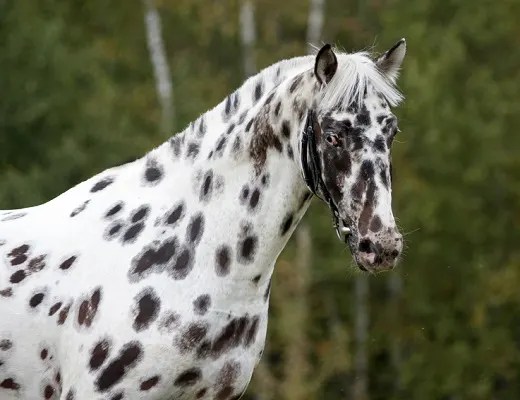
Here they are!! Appaloosas
You probably have read at some point in your life that horses are an introduced mammal species to the continent comprising North, Central, and South America. You probably also have read of the not good uses to which the horses were put. You probably also read these days about the overrunning by wild mustangs in the western plains. Would someone could save them all, love them all. You may have read about or even seen the horses that are beloved, feral, and are a tourist draw on Assateague Island in Virginia.
Appaloosas, of which I am particularly enamored, are said to be mustangs that the Spanish conquerers brought to the Americas. Nez Pierce tribes caught some. They bred them.
Members of the Sahaptin language group,[4] the Nimíipuu were the dominant people of the Columbia Plateau for much of that time,[5] especially after acquiring the horses that led them to breed the Appaloosa horse in the 18th century.
Nez Percé is an exonym given by French Canadianfur traders who visited the area regularly in the late 18th century, meaning literally “pierced nose”. English-speaking traders and settlers adopted the name in turn. Since the late 20th century, the Nez Perce identify most often as Niimíipuu in Sahaptin
When the Niimiipuu first bred Appaloosas, they were called Palouse horses after the Palouse river on their land in Washington and Idaho.
Another Appaloosa
I was about to shift subjects and grouse about news and information media. But why bother.
Instead I will offer this poem by Alberto Alvaro Rios
Dawn Callers
The dawn callers and morning bringers, I hear them as they intend themselves to be heard.
Quick sonic sparks in the morning dark, Hard at the first work of building the great fire.
The soloist rooster in the distance, The cheeping wrens, the stirring, gargling pigeons
Getting ready for the work of a difficult lifetime, The first screet of the peahen in the far field.
All of it a great tag-of-sounds game engaging even the owls The owls with their turned heads and everything else that is animal.
Then, too, the distant thunder of the garbage truck, That lumbering urban whale.
Through it all, the mourning doves say There, there–which is to say, everything is all right.
I believe them. They have said this to me ever since childhood. I hear them, I hear them and I get up.
Alberto Álvaro Ríos A National Book Award finalist, Ríos is Arizona’s inaugural poet laureate. He is a recent chancellor of the Academy of American Poets, director of the Virginia G. Piper Center for Creative Writing, and has taught at Arizona State University since 1982. The poem above is from his book: Not Go Away is My Name (Copper Canyon Press, 2020)
Thanks for reading! May the remainder of this day delight you.
For the past few weeks I keep waking up and thinking about sounds. Usually, listening for birds trying, without looking at the clock, to gauge the time, a song comes into my head, or was already sounding and I become aware of it. I hear the song and if it is a popular or once popular song that appeals to me, I notice that part of that appeal is hearing it in the voice of the singer I have heard it in when it first took hold of me. If it is a hymn I hear a chorus of voices singing it, as for me hymns are best heard chorally.
Then I go and try to sing the song or the hymn, or I hum a few lines of a classical instrumental that I particularly like (sometimes I remember who composed it, and sometimes, to my disappointment, I don’t).
When I sing or hum, I wreck it. I do not like to hear my voice. My outloud voice does not do the music justice to my ears. So I stop and try to revive the professionally or chorally performed piece in my head.
Then I wish it to lull me back to sleep before my thoughts crush in and make so much noise and keep me awake way too long.
This is the first page of the piano score for Hal David’s & Burt Bachrach’s song The Look of Love as sung by Dusty Springfield
As I was typing the paragraph above I asked my memory to touch on a song the singing of which reached me. This is what came up. Dusty Springfield had a voice and a way of using her voice that you had to stop for and just listen. If you have not ever heard it, please do.
This predawn thinking of songs in my head, thus of sound, I moved on to “what is”. I won’t go far in this but have a couple of questions or observations that filtered through me. At first blush, sound is perceived through a “sense”–hearing. There are also the senses of seeing, touching, smelling, and tasting. These five senses express our physicality. They need to impact some facet of our body to be known. And yet, they can be experienced time and time again in our mind.
The very same physicality that I see, hear, touch, smell, taste, someone else can simultaneously, but not identically. And thus, that someone else’s experience is stored in that person’s mind differently than mine is in mine. In the case of Dusty Springfield singing The Look of Love–presumably her voice coming from her mouth, lungs, diaphragm, had the same timbre, pitch, audibility regardless of the listener. Why do we, each of us listening, not hear it the same at the moment of listening? And, in my mind’s memory and the other person’s mind’s memory, is her voice as I/you heard it, or is it as she sang it regardless of how our physical mechanisms’ hearing capacity stores it?
And the person, Dusty Springfield (who, sadly, died in 1999), were I or you ever once in her presence or simply saw a photograph–I only ever saw her on television or on album covers or in print, I would still have a visual of her. And I do. As, possibly, did you and now, once you look below, do you. Is the visual in my mind’s eye the same as yours? How will we ever know?
Dusty Springfield
I know that witness’ statements can never be 100% accurate, because we are, essentially, plunk, standing in our own way–how we experience is always influenced by our own presence, the composition of our molecules, as well as our angle of perspective, health and well being at the moment, mood, past experiences,” etc. etc. etc”. (to quote Yule Brynner in “Anna and the King of Siam”). But the thing in my head that I have stored, that I can recall almost at will, simply by naming (another topic I have been thinking a lot about lately–naming!!)–is it also unique to me, or are your and my mental recall the same? I am pretty sure they are not the same. So, what is the reality of physicality?
And when I come upon someone face to face, do I only sensually perceive that person, or is my mind reshaping who I see even as I am present with that person, or being, or item. Does my physical experience define my perception of a moment? Well, we would probably say that mind influences physical perception, but how does mind maintain the being of that perception? Why does mind recall it when it does, often “out of the blue”? Why does it then slip away, usually unnoticed in its absence? Where does it go? Why can it sometimes be called back and sometimes not?
I believe I have made myself dizzy. I will now sit back and recall Dusty Springfield singing another of her songs–“Stay Awhile”. As a note, she sings sad songs with a voice that is not. You have to listen to the lyrics to know the song is sad. But even still, her voice brings me to a smile of delight.
The sun is already shortening its days with us. Its heat, not so much, sometimes. These days, 2024, Earth, each day seems a season on its own. The days’ weather seems increasingly unpredictable from longer than 8 hours in advance, maybe only 4 hours in advance. Of course, that may vary by a few hours hear and there depending on which of the myriad weather predictors one references. One day recently as I stood outside beside the back yard, it began to rain, as I was on my way away, I had my phone in my pocket. I took it out and looked at the well-worn weather app. It said cloudy, and made no rain mention, now nor soon. To be fair, the rain only lasted three minutes. And, then the steam rose.
I do not complain, I note. I do not complain because here in New England, we have not endured the excruciating heat Hajj pilgrims in the Middle East are currently finding many among their number dying from, nor the rain soaking the ground so prolongedly that in parts of Europe crops have not been able to be sown (never mind reaped!), because the ground cannot hold them, nor the flooding in the north central portion of this country, and so on. Here, I can flick on a ceiling fan if need be; I can change clothes to suit the temperature; I can pour myself a glass of water.
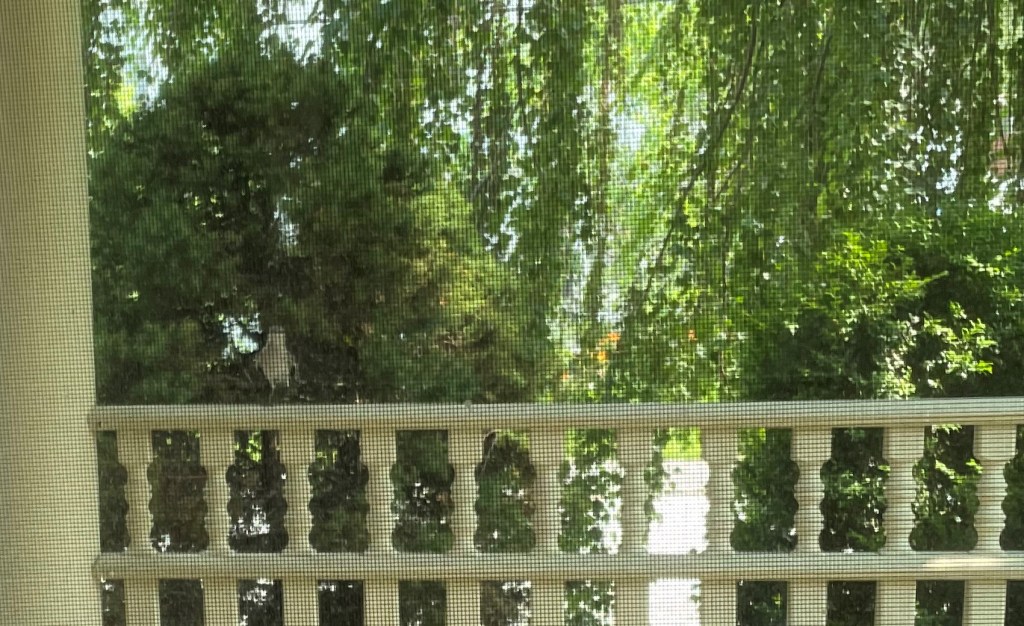
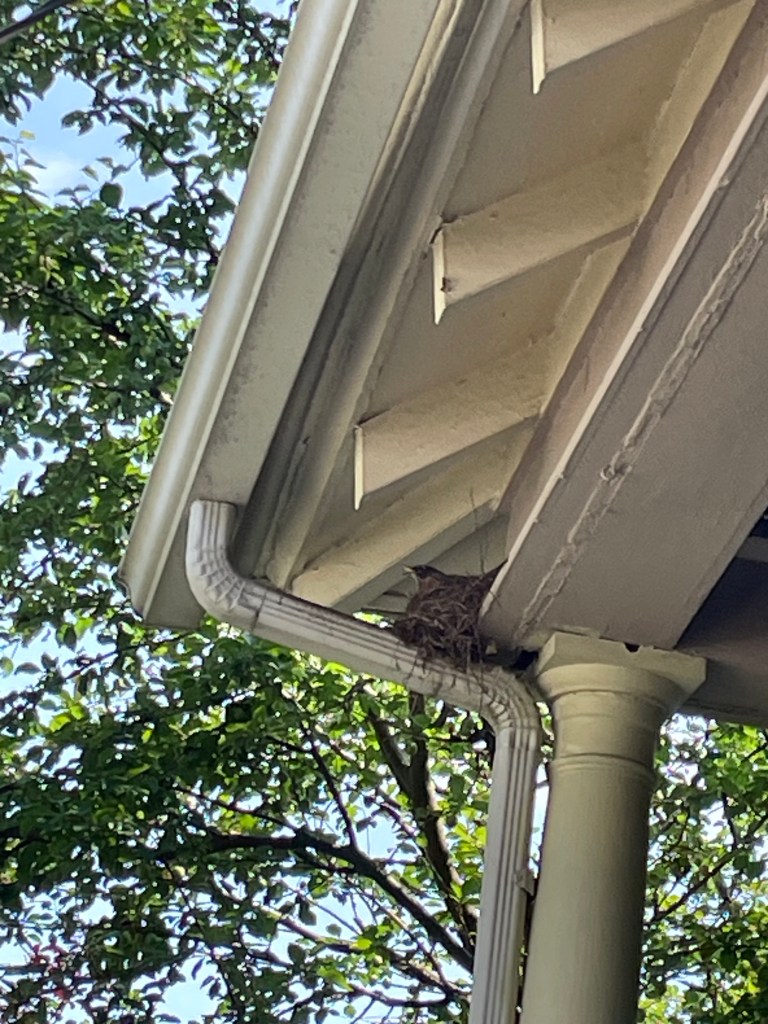
I can watch a pair of robins guard the nest they built atop one of my porch columns.
I can also watch, as I did this morning, a robin and a chipmunk spar over an insect? A worm? A berry? The chipmunk prevailed, the robin squawked and flew up away, landing 20 feet further along the ground, finding her own sustenance.
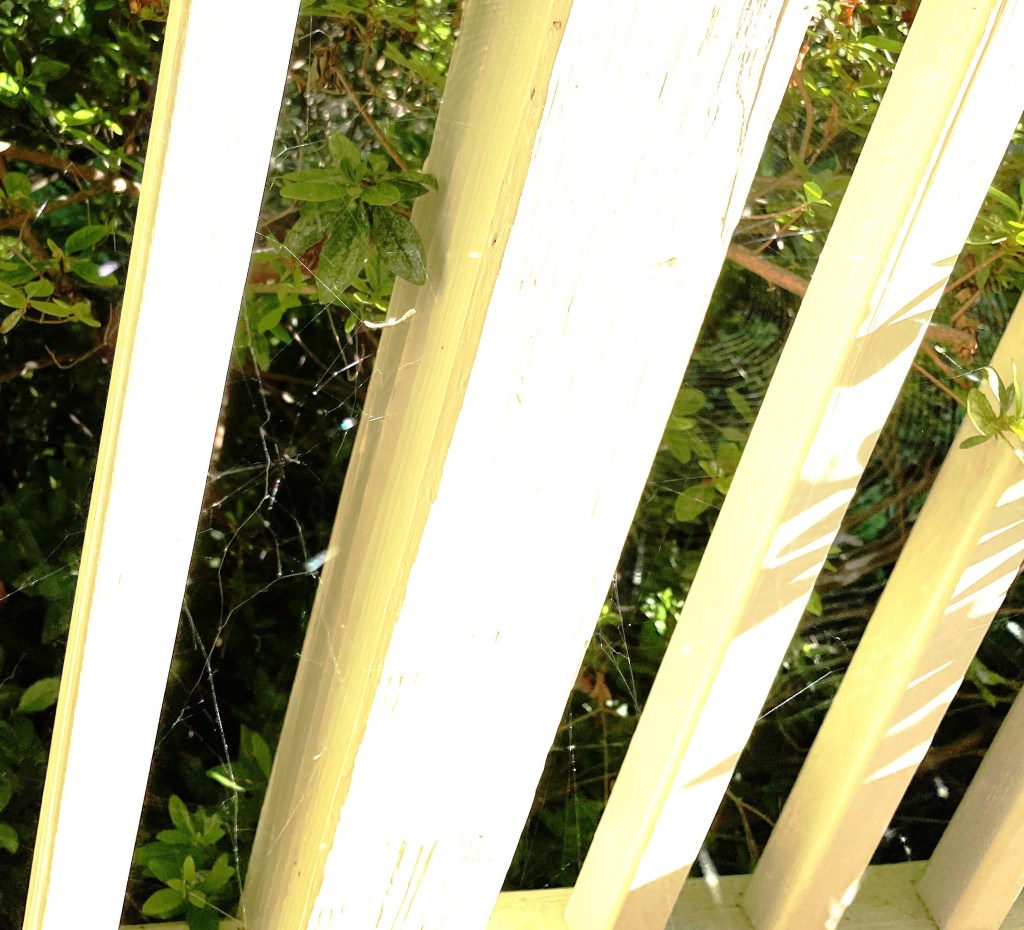
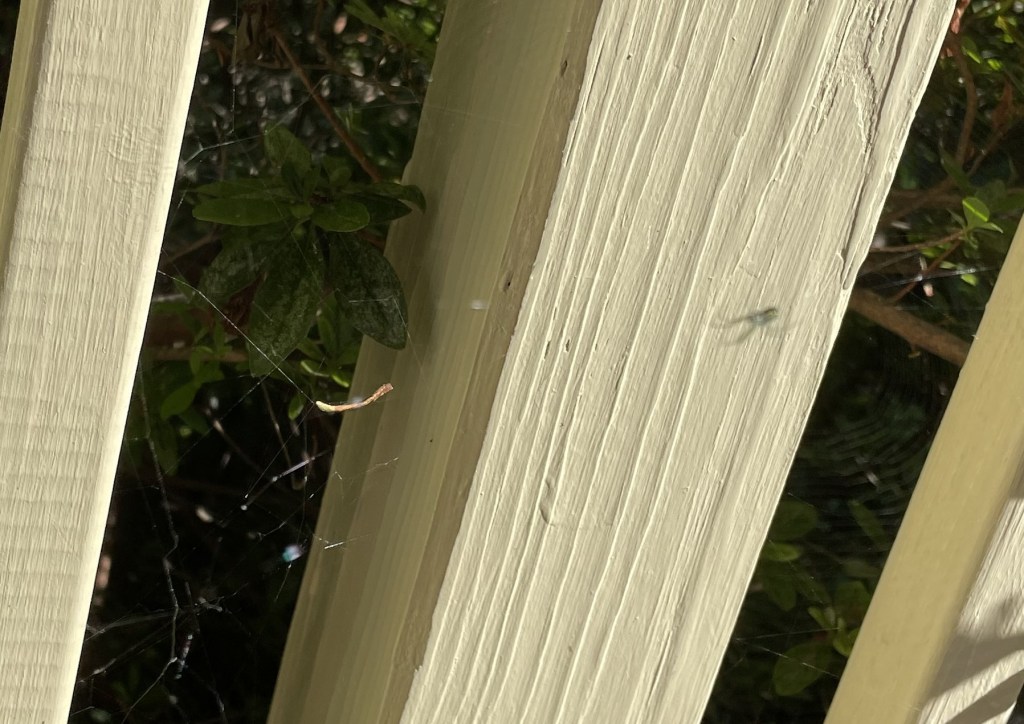
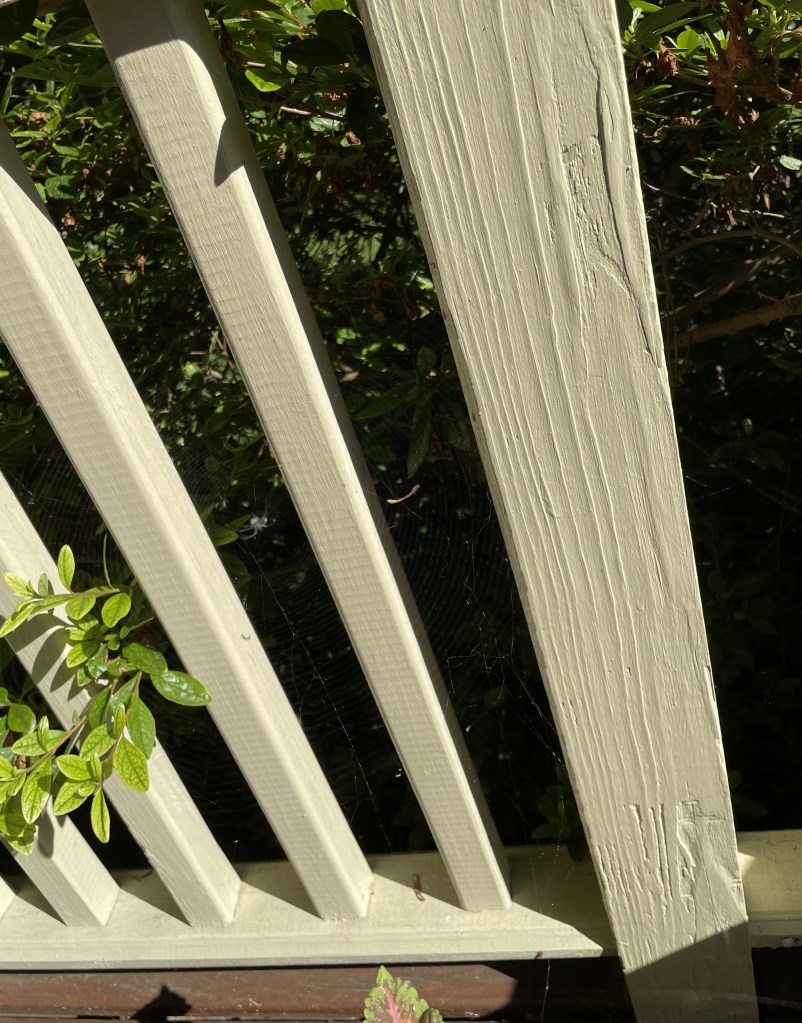
I can see, and be amazed, and try, not too effectively, to photograph a three or four level spider web attaching my porch railings to a coleus I am trying to make well, a branch of the azalea bush behind the railings, a small table and a chair I have placed, and until this morning, have used (not to worry, I have other chairs set up, and table, which I populate and use)
web visible among and in front of slatsspider visible against postWeb and, if you look carefully, between slats just about center picture, spider
Excuse me. I was away for awhile. I wondered at the genus of a spider. Oh what web I wove!! (sorry, couldn’t pass up the pun) I will give you a list that begins to define this particular spider, but actually stops so far short:
domain–Eukaryota (all eukaryota have cell nuclei) kingdom–animalia phylum–chordata (chordata have five distinct characteristics such as a hollow tube spine, ….) [subphylum–chelicerata–chittin exoskeleton] class–arachaida order–araneae [suborder–araneumorphae–web weaver] family–araneidae genus–there are 184 genera within the araneidae family that this spider could be, I did not dig in species–there are 3,097 species within the 184 genera within the araneidae family that this spider could be, I did not dig in.
Someone(s) identified this deep, so far. How much more life threading through every tangible, breathable/breathing, potentially visible, potentially audible… particle is there. SomeONE made life (life sits above domain in the scientifically defined hierarchical list I provided above, it is the basis/source of all else that tumbles down the list, that tumbles down and climbs back up, that interacts with all the other species, genera, families, orders, classes, phyla, domains categorized somewhere on that hierarchical list). Imagine that.
Psalm 139: 1, 7, 17-18
I wonder as I wander what we are doing with this life. Why?
Is when I begin this piece. It would appear that I am not to sleep tonight. I woke up about two hours ago. I got up about an hour ago. The birds, the robins, specifically, began their predawn song about 15 minutes ago back behind me through the kitchen window. I am at my desk in the front of my house. My house is not so big that I can’t hear from any room what is going on in or outside of any other room (the outside part assumes that I have windows open, which I do, as it is not winter). If I were in bed, I could hear the robins better, and perhaps, by now the sparrows have chimed in. Also, I will hear the robins better as the hour passes, because approximately every ten minutes the robin song moves closer to my house. I don’t get why they seem to start in the northwest and continue towards southeast, but this is how it goes, each morning rise. As you may have guessed, I have been awakening pretty early of late. Usually, however, I fall back to sleep. Not this morning!
These are the dove family I mentioned in last post. The loner on the right is, I believe, the child. The doves, I have noticed, are the last birds to herald dawn, while the robins are the first each morning.
If you’re in New England at least, you have enjoyed the profusion of blossoms have been this spring. And now this almost summer they continue, along with a lot of butterflies (probably moths, these are something I know very little about and have read not much about, except the increasing challenge to the number of monarchs, and, presumably, others, as this challenge in numbers beleaguers just about all species, except, human.), or perhaps moths, of sizes and colors I have not seen before. I have seen thumb size versions of monarchs. I have seen translucent white ones also no larger than my thumb, and not, I am sure, the cabbage moths that chew on my brassicaceae (sp?) efforts in the vegetable patch. I have seen perfectly outlined gray and black ones including this one clutching the screen of one of my living room windows.
Here’s the grey guy. (Twice because I liked it so much)
Have you noticed the excessive size of my shrub? I have four too large shrubs out front. They keep me a secret year round. I do wish I had known, probably 10 years ago that I was supposed to trim them at a certain time each year. When I finally learned it, I also realized that the supposed best time is also the time when early birds begin to build nests. So I didn’t trim. But, in the past couple year or so, I have been informed that there are two good windows for trimming shrubs. Perhaps I will remember in October to do a trim. The question is, will I do a reasonable one, or will I give them a dramatic cutback, and then cry in the spring when I realize I overdid it? A question to be answered next year. Perhaps next April I will remember that I subjected you to this dilemmic discussion and let you know the outcome. Do not feel the need to sit on tenterhooks until then!!
I’ve been enjoying my arugula in salads (along with violet leaves and dandelion leaves and mint, as I have probably said before, no pesticide has touched this backyard of mine for going on 17 years, so I feel pretty confident in it) for several weeks yet, and I happily discovered that the radishes grew abundantly this year. So much less stinging to the taste buds than those bought in the produce market. Funny.
Two lima bean plant shoots are striking out and up. I can only hope. Two or three cilantro shoots are emerging. Two shoots of something, I don’t remember what, that I planted in a pot on the back porch are beginning to take their stand. But the pickling cucumber shoots did not emerge. And I have gone to three garden centers so far and not found a pickling cucumber plant. Ah me. Did buy and plant four types of tomatoes, one serrano pepper plant (why not?), one rosemary plant, and one basil plant, and one sage plant. I read that the sage plant, even in New England, is perennial. Not sure I believe that. And, tapping the back of my mind is a thought that at another time I may have read that they come back every other year (although, that may have been brussels sprouts! Oh, that I were a more thorough researcher.)
As a final note, since it is still spring, and since it will next be summer, here is some very important information for you:
A cut from a Phil Rizzuto baseball play by play, pasted into the song Paradise by the Dashboard Light; sung by Meatloaf; written by Jim Steinman. (1977- from a long-playing (LP) record album by Meatloaf that I played over and over until the grooves ran smooth)
Well I guess sometimes a repeat is necessary. And is good. Sometimes when I read, I just have to read that paragraph, the page, even that chapter over again. Right then, not, as I am wont to do, 5 or 6 years later. Right then, and there arises so much that I had not gotten when I read it just 30 seconds, or 2 minutes ago. There it sat, in print, ready to be read (red); I only had to read (reed).
This is a book pages holder-open. Have you ever seen one before?
Sometimes a day just does not stop being good.
Today I had the sweet delight of being with some people I had not been in the presence of for 30 years. We have had occasional electronic media conversations. But to touch the cloth of their shirts, jackets while hugging and being hugged brings, brought to my heart warmth, and to my mind wide awake memories. Memories of those I embraced, and of those I saw across a space, and memories of those who were not anymore–especially voices. I can hear each voice as once it had regularly been within our shared presence. And a voice takes along with it many pictures, moving and still, and it is sometimes the best gift one can receive. I am grateful.
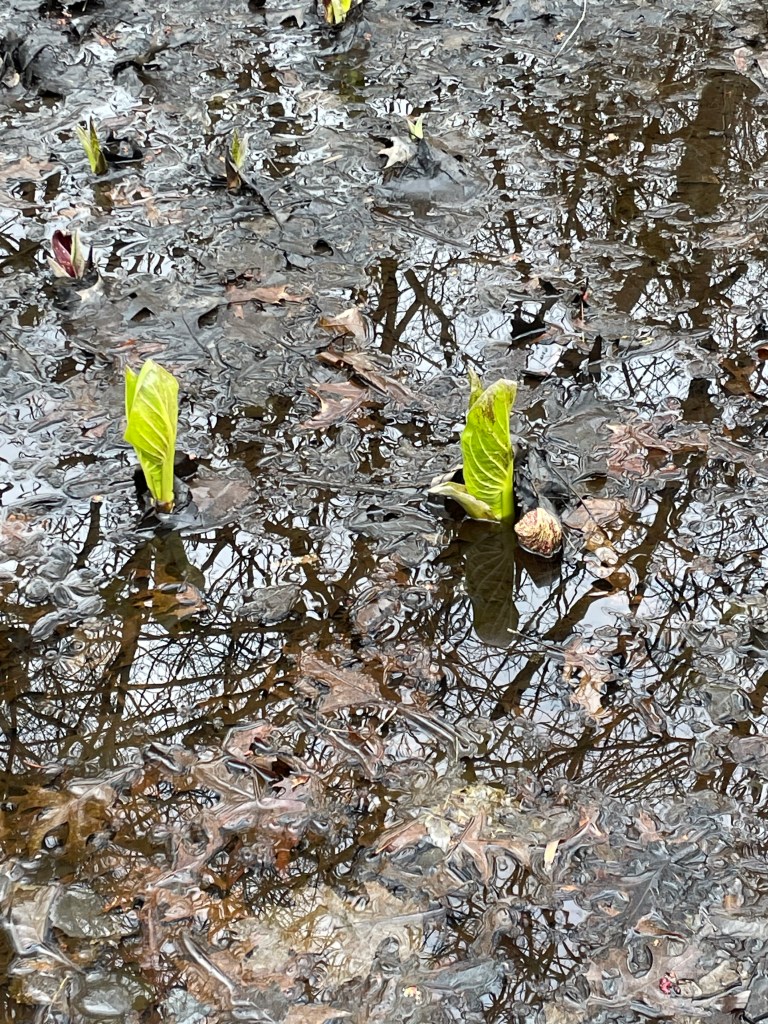
Today also, earlier in the day, in the morning, I walked with a friend through a nicely wild arboretum, wherein trees as tall as hills, it felt like, towered over us–tulip poplars, american elms, red, scarlet, white, chestnut oaks, a venerable gingko in an open space all its own. And there were wildflowers abounding. And shrubs clutching. And birds chirping. And there were marshes with freshwater bog grasses, stands of skunk cabbage, and well disguised frogs!
can you find the frog? center!
And later today I had a car repair re-repaired. And the mechanics were so helpful, so immediate in their helpfulness, and it was a success!
Sometimes a day is just as wonderful as you could want.
My irises are going nuts this year (this is just a portion of them), and the plum tree above them is fruiting voluminously!!
Then I find myself breathing and smiling at the same time and I find I can see so many lights sharing surfaces including the very air that I am breathing and happily smiling within. This morning as I pedaled in the still cold, but scintillating bright air, I heard two warblers, pausing in my favorite utility cut on their way north (for these two, north from here could be further up the cut, or could be Maine, Canada)–a pine warbler and a chestnut sided warbler.
Pine Warbler, photo courtesy of Cornell Labs eBird pagesChestnut-sided warbler, photo courtesy of eBird pages
And in the environs of my house with my postage stamp backyard, and deeply shrubbed front yard, I enjoy the arrival and now growth to majority, of a mourning dove. The child dove perches in various locations front and back of the house, on structures, or on/in the grass, and the parents hover, heads together, perhaps discussing the child’s progress or better, just the beauty of their child.
Child mourning dove on the planter in which I grow sage, basil, rosemary. Notice the variety of grasses and such. Such is my lawn “care”. The violet leaves are edible, and tasty!The immature mourning dove on the front porch, posing before two of my four overgrown shrubs, and backed by the rustling weeping birch, which, when it leafs out will provide a wall. There are those among us (me) who never remember the right time to trim, until it is just past, and we must wait until the next “right time”. But look at that dove! Such a beauty.
I am not sure where the doves have located their nest this year. It very well may be in one of the shrubs. Two years ago it was in my neighbor’s cherry tree that hangs prettily over my driveway. That was a delight to watch. Last year it was in the top northwest corner of a behind-me-and-to-the-east neighbor’s within the gutter, behind the downspout from the roof. That nest, this year, is home to a mockingbird couple. I don’t believe their young have hatched yet, but I could be wrong. Mockingbirds seem to either perch very high and sing their repertoire, putting it on repeat for awhile, or they are flitting, quickly landing and launching, such that who can know whether they are adults or youth?
I also was visited one dank day several weeks ago, well, let me rephrase that, the neighbor’s cherry tree that overlooks my driveway, was visited by a crew of cedar waxwings!! Oh, I was very happy. It was, I believe, the last snow we had, well, snow/rain/sleet/hail/snow/rain episode that we had. That may have been in this month of April, may have been late March. I forget. Do you remember weather once it has occurred?
Where’s Waldo? There are four cedar waxwings in this photograph. Do you see them?
I am tempted to once again include ee cummings’ poem. But I will not. Instead, I will give you Billy Collins. Some might term him iconoclastic, others might term him pedestrian; I find him a simultaneously most accessible and puzzling poet:
morning of 4.4.2024 but winds, evidenced in the weeping branches sideways action, are carryover from 4.3.2024
It rained and winds blew, blew me around as I tried to stand my ground, and then, on the 4th day of the 4th month of 2024, it snowed. And today, the following day, the snow is punctuated by blades of grass, tenacious hyacinth buds, tulip and jonquil leaves becoming tall, stately. The snow is lusterless.
With the snow, the juncos returned to my backyard. Where were they? I thought they had gone for the season, and then, snow falls and juncos fly in.
With the snow, the robins were unperturbed. They chuckled. The mockingbirds, mocked. And, very exciting in their rarity in my patch of land, four cedar waxwings visited and chowed down on the cherries of my neighbor’s cherry tree at the foot of my driveway!! I was shoving weighty, wet snow from the driveway with my pitiful shovel, just because, and I heard a robin in that tree and looked up. There it sat, selecting cherries. And then my gaze drifted a bit left, and there quietly, but in unison, the four cedar waxwings, tugging and chewing the cherries. I watched for a span of time, motionless, and they stayed and stayed.
and here, late afternoon 4.4.2024 cedar waxwings enjoying the fruit of my neighbor’s tree
Yesterday, to go out, I put on my winter shoes. I had been sure just a week ago that they were stowed away until maybe November. Oh how mistaken I was. I have come to wonder if the term “seasonal” will fall into disuse as such a predictability becomes not.
This morning I read that the waters in some area of the oceans are warmer by a lot than generally are now, and that bodes for another record breaking hurricane season this year. In 2023 El Nino was blamed.
NOAA explains El Niño as such: The warmer waters cause the Pacific jet stream to move south of its neutral position. With this shift, areas in the northern U.S. and Canada are dryer and warmer than usual. But in the U.S. Gulf Coast and Southeast, these periods are wetter than usual and have increased flooding.
Invisibly to you, it has been an hour since I entered the above paragraph. I have been, all this time, reading about El Nino and La Nina, their patterns and anomalies over the years therefrom. I observe that, short of hugely broad ranges of assumptions, the weather impacts of these two climate affecting patterns are pretty unpredictable. And the annual warming by the billions of smaller causes (i.e., us), tilts the statistics and climatologists and meteorologists rely on, monkeying with their models and disturbing their accuracy. So, I observe, I need to go outside, look up at the sky–look east, look west, look north, look south; stand still and feel from which direction(s) the wind is coming; how big and high are the clouds?; are there any clouds?; how weighty does the air feel on my lungs?; how urgent or lazy do the birds appear to be at the moment?; what is the weather today 100 or 500 miles west of me? (or northwest, or southwest, or southeast, or northeast, or even east–all depending on whence the wind is blowing, or drifting)–then I can get a sense of today and tomorrow.
Long term predictions–ranges maybe, patterns a little less maybe, specifics nah.
On that note, I have yet to clear the oak leaf layer I placed on my vegetable and flower gardens last October/November. I can tell you, I am glad of that. Will I be glad later this spring and summer? Will my vegetables grow sufficiently with this late seeding? Will they bolt because the weather suddenly is steamy? Will they thrive?
And, further on that note, I read this: Scientists have also observed that CO2 levels in the atmosphere increase during El Niño events, possibly as a result of warmer and drier conditions in tropical regions.
If plants grow less quickly due to drought, they absorb less CO2, while more wildfires in places like South Asia mean more CO2 is released.
One final rant: So now “experts” are researching, planning, maybe already doing–burying CO2 waste deep underground, AND deep under the sea! Go team, let’s poison the sea life from below as well as from above as well as from within (I am thinking of the already terrible fact of zillions+ tiny plastic elements free ranging through the oceans, becoming one with the bodies of aquatic beings. I am thinking of sinkholes giving under the weight of surface development and burping CO2 from its “buried” place. I am thinking of the many out of the way areas in the world host to waste of atomic trials.)
I bet that when you began to read this post you thought you were going to get away easy. I kind of did, myself. But then I kept thinking, then typing. Here you have it.
Here is a concept: hope. Can we? We can. Need we? We do. While sitting on our hands? No.
It is 2:24am. It’s been awhile, several years since I found myself wide awake and dawn hours away. I went outside to see what I could see of the sky. Took some maneuvering between streetlights, across-the-street neighbors’ safety lights, and other neighbors’ inside-the-house lights all thrusting their respective glares, but, standing in my driveway within the shadow (yes even in dark, shadows) of my house and my easterly neighbor’s house, making binoculars of my two hands wrapped around the perimeters of my eyes I saw ursa minor over the backyard, and turning around I think I saw castor and pollux bright behind me over the street at my back. I took a picture of ursa minor. Three stars in their line showed up on the picture, that was the range my phonecamera could capture. But you know what else, was it dust in the air local to my body, ground level air interfering with my photograph, or, was it atmospheric dust a few to dozens of feet above me, or was it billions of stars littering, making impossibly ununiform the rest of the picture my phonecamera captured?
I don’t know. I tried to upload the photograph from my phone to my laptop. The software will not let me. Too dark for my laptop’s eyes. I leave it to you to try this yourself. Step outside, stare at the stars you can see, take a picture, look at the picture, what else do you see? Look up at the sky again, what more do you see now?
This was the night to do this, perhaps that’s why I woke up. It is the first not full of clouds day and night combination in quite awhile. And, at 2:24am the wind had gone away too. It is now 3:44 (I spent some time looking through my National Geographic Pocket Guide: Night Sky, and some time watching/listening to Cat Stevens/Yusuf Islam youtube videos. I am fan of his, and I believe I have all but one of his Cat Stevens’ albums from the 1970s. It is 2024 and Yusuf is still singing with a voice that is almost identical to 1974.)
Morning has broken like the first morning, blackbird has spoken like the first bird. Praise for the singing, praise for the morning. Praise for them springing, fresh from the Word.
You can find the rest of the lyrics to this song of his online. It’s from his album, Teaser and the Firecat. I read that this song’s origins are in a Scottish hymn.
How has your March been so far? The other day I was walking, bending against headwinds and suddenly it occurred to me–March!! March winds storming in like a lion and lilting out like a lamb. When was the last time that elementary school lesson spoke to me? And how has it taken so long for me to recognize the factuality of that little phrase “in like a lion out like a lamb”? So much of our learning is grounded in life lived. We need only open up and understand.
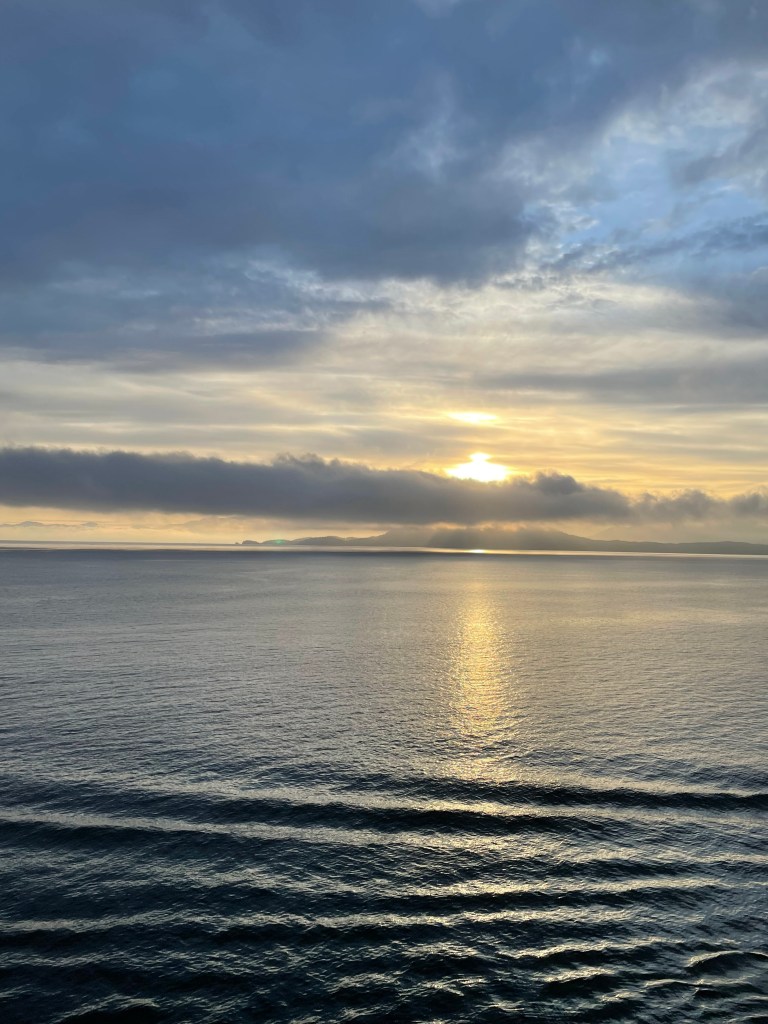
A week ago I stood at the ocean, buffeted and pelleted, but awed.
This morning I stood in still air, tossed by nothing, and yes, awed.
The following is information I found on Seasky.org
Ursa Minor contains only 3 stars brighter than magnitude 4. Polaris, the North Star, is the brightest with a visual magnitude of 1.98. It is a multiple star system that contains at least three individual stars. It is located about 434 light years from Earth. The second brightest star in the constellation is Kocab with a magnitude of 2.08. It is an orange giant star that lies about 130 light years from our solar system. Pherkad is the third brightest star with a magnitude of 3.05. It is a yellow-white giant star located approximately 487 light years away.
The constellation Ursa Minor, the little bear, is visible in the northern hemisphere all year long. It is a circumpolar constellation, which means it is visible all night as it rotates around the north celestial pole. It is a small constellation covering an area of 256 square degrees. It ranks 56th in size among the 88 constellations in the night sky. It is famous for a group of stars known as the Little Dipper and for Polaris, the North Star, which is located at the tip of the dipper’s handle. Polaris is called the North Star because it is the closest star to the north celestial pole. This means that as the Earth rotates, Polaris appears to remain stationary in the sky while all of the other stars rotate around it. Because the Earth wobbles slightly as it rotates on its axis, Polaris will not always be the North Star. In about 14,000 years the north celestial pole will point away from Polaris and toward Vega. This process is known as procession. Polaris is an important star for navigation, allowing mariners to easily identify their latitude