What did you do so far today?
Here it is beautiful. Especially since yesterday was a trick day, sun bright and kind, but humidity in place (until late afternoon) and unkind. Yesterday and Friday air felt like not a boa, not a scarf, not even a wool coat, it was not just heavy, but unwieldy, like carrying a full size futon mattress up a staircase.
Today I was not only able, but willing to pedal up hills nearly as readily as on flat plains (planes?).
This morning I went to church. I do on Sundays. I wore a skirt. I often do, or a dress. It’s almost my only chance to do so. Every summer I think, I should get a few more skirts and wear them, loose ones, flowy ones. But then I remember the chain on my bicycle, and I do not consider getting more skirts this summer. When I worked, in the winter when I would bicycle to the train station I would have on my winter coat, and it is almost to my ankles; I would steer with one hand and hold the coat hem aloft with the other, hoping no car would cut me off requiring braking and/or veering left or right. I had a couple of skirts, too, that sought to catch in the bicycle chain, succeeding once or twice. Mostly I managed. I remember the movie, Butch Cassidy and the Sundance Kid, Katherine Ross rode side saddle — on the bicycle? as well as on a horse? What would side saddle feel like, besides, not stable?
I love horses. Rode them a few times in Kissena Park in Queens, NYC. It was an astonishing (still is) swath of green space surrounded by city–highways, local urban streets, apartment buildings, houses, shopping areas, rumbling trucks, belching buses, honking cars. Yet in the park then, a long time ago now, and to some extent I think still, you lost that din, for just awhile and felt the rolling muscles of the horse you rode, slowly–these were trail rides established for we urban, inexperienced, nearly incapable riders, on nearly retired Palominos, Appaloosas, Quarter Horses, Arabians, maybe a Morgan? All large, and all patient. I have ridden a horse now and again in more rural settings in New Hampshire and in Massachusetts, maybe once in Pennsylvania. Never loosely and as someone knowing what I am doing. Because astride a horse’s back I do not. Alas.

You probably have read at some point in your life that horses are an introduced mammal species to the continent comprising North, Central, and South America. You probably also have read of the not good uses to which the horses were put. You probably also read these days about the overrunning by wild mustangs in the western plains. Would someone could save them all, love them all. You may have read about or even seen the horses that are beloved, feral, and are a tourist draw on Assateague Island in Virginia.
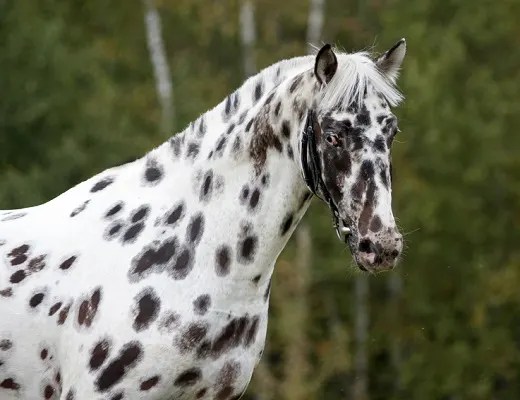
Appaloosas, of which I am particularly enamored, are said to be mustangs that the Spanish conquerers brought to the Americas. Nez Pierce tribes caught some. They bred them.
The Nez Perce (/ˌnɛzˈpɜːrs, ˌnɛs-/; autonym in Nez Perce language: nimíipuu, meaning “we, the people”)[2] are an Indigenous people of the Plateau who still live on a fraction of the lands on the southeastern Columbia River Plateau in the Pacific Northwest. This region has been occupied for at least 11,500 years.
Members of the Sahaptin language group,[4] the Nimíipuu were the dominant people of the Columbia Plateau for much of that time,[5] especially after acquiring the horses that led them to breed the Appaloosa horse in the 18th century.
Nez Percé is an exonym given by French Canadian fur traders who visited the area regularly in the late 18th century, meaning literally “pierced nose”. English-speaking traders and settlers adopted the name in turn. Since the late 20th century, the Nez Perce identify most often as Niimíipuu in Sahaptin
When the Niimiipuu first bred Appaloosas, they were called Palouse horses after the Palouse river on their land in Washington and Idaho.
I was about to shift subjects and grouse about news and information media. But why bother.
Instead I will offer this poem by Alberto Alvaro Rios
Dawn Callers
The dawn callers and morning bringers,
I hear them as they intend themselves to be heard.
Quick sonic sparks in the morning dark,
Hard at the first work of building the great fire.
The soloist rooster in the distance,
The cheeping wrens, the stirring, gargling pigeons
Getting ready for the work of a difficult lifetime,
The first screet of the peahen in the far field.
All of it a great tag-of-sounds game engaging even the owls
The owls with their turned heads and everything else that is animal.
Then, too, the distant thunder of the garbage truck,
That lumbering urban whale.
Through it all, the mourning doves say
There, there–which is to say, everything is all right.
I believe them. They have said this to me ever since childhood.
I hear them, I hear them and I get up.
Alberto Álvaro Ríos A National Book Award finalist, Ríos is Arizona’s inaugural poet laureate. He is a recent chancellor of the Academy of American Poets, director of the Virginia G. Piper Center for Creative Writing, and has taught at Arizona State University since 1982. The poem above is from his book: Not Go Away is My Name (Copper Canyon Press, 2020)
Thanks for reading! May the remainder of this day delight you.

 whereIwonder&why