Good Saturday morning. It is early. It is cool. I have had a cup and a half of coffee and am considering brewing another pot. (French press; I brew enough at a time that it is marked on the pot as 3 cups, but I only get 1 1/2 cups/mugs per brew, and some days I just love coffee especially much. Today is one. I’ll be back shortly.)
Tomorrow, I just read, summer returns–into the 70s here, and 80s by Tuesday. Across the street my neighbor’s brother’s Honda Element is parked and carries a pink bicycle on a carrier. The tires are even pink! Three, no four, no five shades of pink on that cycle–seat, basket, frame, pedals, tires. Only the handle bars are chrome. I am surprised there aren’t tassels streaming from the handle bar ends. Oh, there it goes –Element driving away toting the pink bicycle. I guess someone has been to see the Barbie movie. I have not. Have you?
So, where am I going with this? I am at sixes and sevens. Where does that expression come from? I looked it up. Many uncertain responses (how appropriate): The wikipedia one includes: “It is not known for certain, but the most likely origin of the phrase is the dice game “hazard“, a more complicated version of the modern game of craps.” Michael Quinion, a British etymologist, writing on his website on linguistics, says, “It is thought that the expression was originally to set on cinque and sice (from the French numerals for five and six). These were apparently the most risky numbers to shoot for (‘to set on’) and anyone who tried for them was considered careless or confused.”
And further, still from the Wikipedia entry: “A similar phrase, “to set the world on six and seven”, is used by Geoffrey Chaucer in his Troilus and Criseyde. It dates from the mid-1380s and seems from its context to mean “to hazard the world” or “to risk one’s life”.[2] William Shakespeare uses a similar phrase in Richard II (around 1595), “But time will not permit: all is uneven, And every thing is left at six and seven”.
These explanations leave me just there, at six and seven, or am I at five and six? The choice leaves me at sea! Well, I will decide, since I am writing in the English language, I will stay at sixes and sevens. Although cinque et sice rolls off the tongue nicely, not having to use the throat as gutturally as sixes and sevens. Say them out loud, I think you’ll feel what I mean.
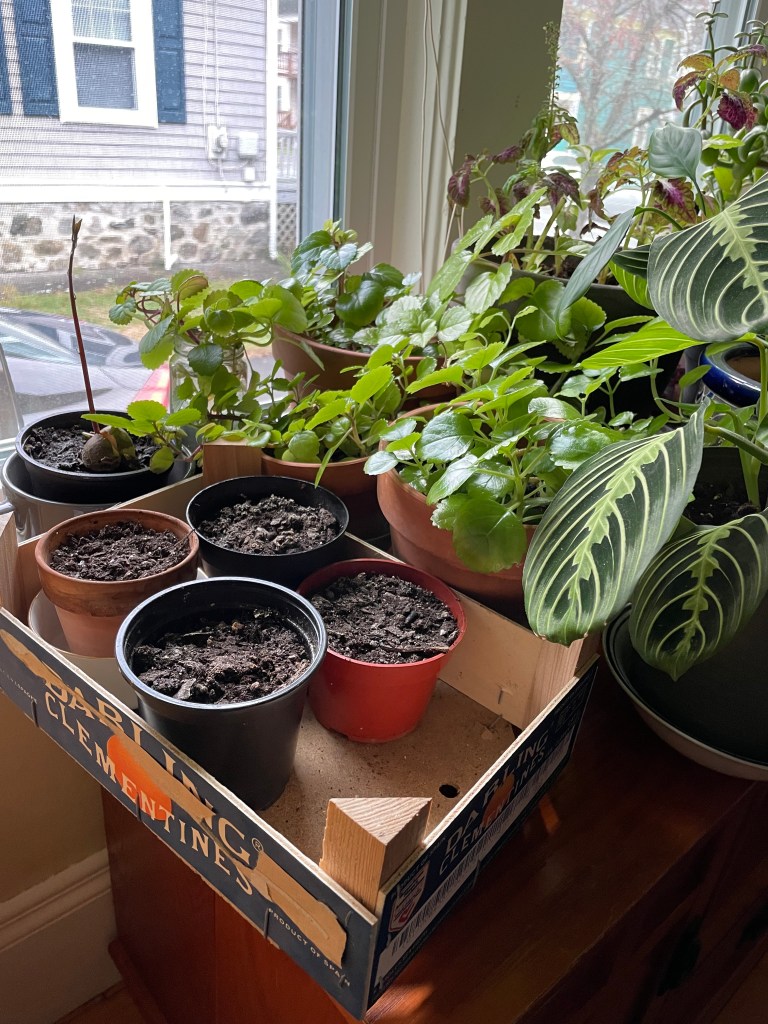
You know, we’re in a lot of trouble in this world. I stew over it. I plant little trees all over the place (very little, so that public works people won’t uproot them as wrong for the place, as not likely to thrive.) My backyard the willingest recipient of my experiments. And in among the plants I have in pots in the diningroom I now have four beechnuts in pots. I have faith one or all will emerge. I don’t know.
I also pushed a fifth beechnut into a pot in the backyard, the pot right next to the pot of rosemary, which is next to the pot of sage, which is next to the pot of tomato and basil.
Here is a painting I would like to share. It is called Braces’s Rock, and is painted by Fitz Henry Lane in 1864.
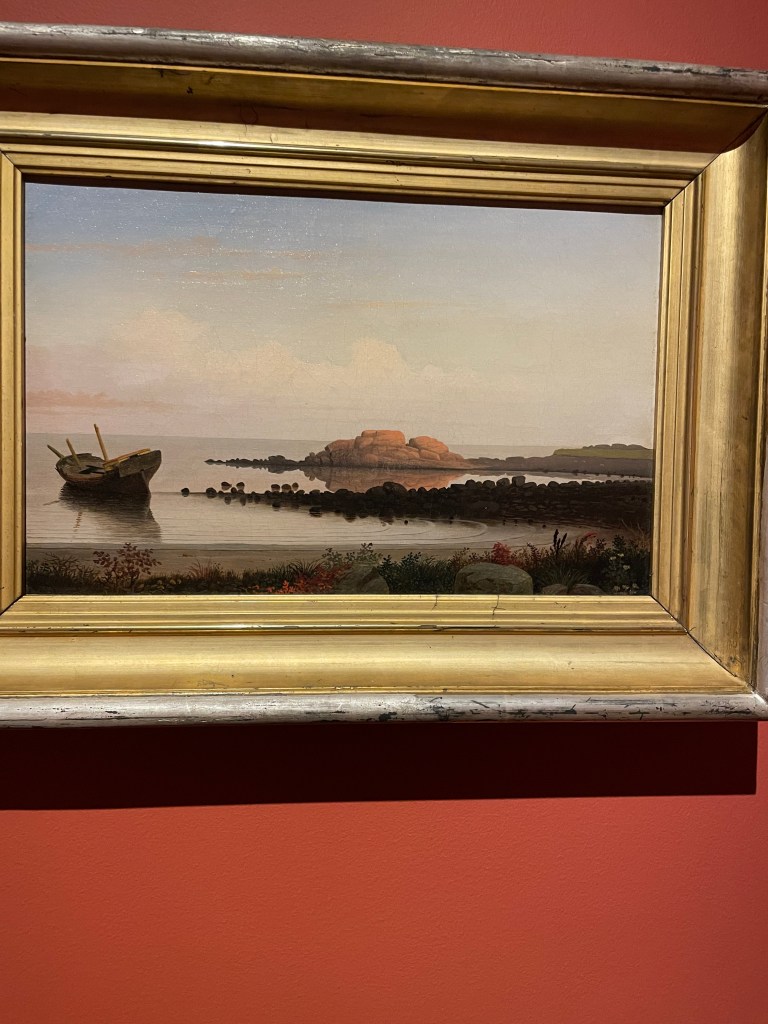
I saw it and was captured. I stood in front of it at the Cape Ann Museum for, oh, ten or more minutes. Paused. Immovable. At peace. And yet: Brace’s Rock (Brace’s Cove) is historically one of the worst sailing hazards on the entire New England coast. “It deceptively appears to be an entrance to Gloucester harbor. Nowhere on Cape Ann is the illusion of a peaceful ocean more pronounced that Brace’s Cove seen on a still summer afternoon.” (from Brace’s Rock Series written by Sam Holdsworth, in an online project under the direction of the Cape Ann Museum) For just that small space of time just I standing before that small ripple of water, that strand of beach. Inattentive to the beached, broken boat.
Oh the places I could go with a conversation about this. What do we see when we look? What don’t we? Do we not because we turn? because we blink? because we won’t? or because we can’t?
But I am stopping here. Because I began with a cool, early morning. The morning has aged two and a half hours. I just had a visit from some local faith based visitors. They have come to my door before, with tracts and smiles and Jehovah. We converse. They will come again. We will converse again. They are very nice. They are ardent. As am I in what I hold as my story with God.
As I am in what I wish.
May we find peace. May we understand love. May we give it.

 whereIwonder&why